If you wish to adjust your cookie preferences for this website, you can do so using your browser settings.






 Female Clothing
 Accessories
 Furniture
 Tents
Tents Armament
 HMB Line
 Miscellaneous
 Rent
Rent In stock
 Special Offers
 Search
 Your Account
 About us
 Sizing
 How to buy
 Blog
Blog Links
Links Events
 info@medieval-market.com
 medieval.market
Medieval clothing for men
Between the 13th and 15th century, costumes for men have undergone similar changes as female clothing. In the 13th century medieval clothes were loose and not fitted to the body (cotte,
surcoat).
Around half of the 14th century, medieval clothing became more fitted ( cotehardie,
later doublet). Closer to the end of the 14th century, very spacious outfits started to appear (houppelande, robe) which were used simultaneously with other types of medieval clothing.
Medieval fashion in the form of 15th century clothing, together with still popular hose, allowed males to use hose, allowed males to use pants. Aside from civil medieval clothes, adequate social classes had a dedicated knight medieval outfit, which consisted of quilted medieval clothing (arming garments) and armament.

Medieval clothing: underwear & body linen inspired by the medieval fashion
Medieval underwear & body linen for men
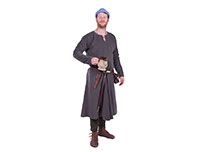
Medieval clothing: various under garments from the medieval fashion
Medieval under clothing for men
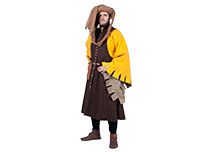
Medieval clothing: popular outer medieval clothes of high quality
MMedieval outer clothing for men
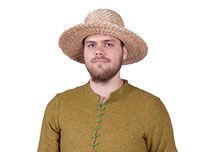
Medieval clothing: hats & hoods to complete a medieval outfit
Medieval headwear for men
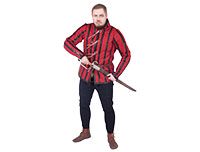
Medieval clothing: gambesons, pourpoints, doublets & quilted accessories for fighters
Medieval arming garments & quilted medieval clothes for men
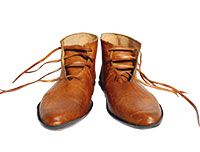
Medieval clothing: leather shoes for townsmen, knights & soldiers, inspired by medieval fashion
Medieval shoes for men
Examples of men's medieval clothes from the 10th-15th century period
True lovers of the former fashion have a chance to assemble a high quality set of medieval clothes. Examples of medieval clothing you can find here are: medieval body linen for men (medieval men's shirts and braies), undergarments (men's cotte, doublet, hose, pants, tunics), outer garments (cotehardie, Franciscan habit, houppelande, jopula, coats, robe, surcoat, tunic from 14th century), headwear.
It is worth taking a look at knight' and arming garments and medieval shoes. Wide range of medieval clothing available in our shop gives you a chance of assembling a truly unique set of men's outfit referring to 10th-15th century clothes.
Medieval clothing over the centuries - what are the changes in fashion?
This assortment faithfully replicates the specificity of the former fashion. Outfits are based on historical sources which allow precise recreation of all the elements of male medieval clothes.
Here you have an opportunity to choose from medieval clothing starting from the 10th century and finishing in the 15th century. Fabrics used in the production of our medieval clothes are typical for this period. It gives a chance to feel the vibe of the former times. What is more, SPES gives you an opportunity to choose not only from casual, everyday medieval clothes, but also from medieval clothing for knights.
Leather shoes are available in two variants: hand-sewn or machine-sewn. We offer a wide range of coats of different lengths, inspired by 13th, 14th, as well as 15th century clothing.
What is more, the available assortment contains a lot of various gambesons and other medieval clothing for fighters.
What makes high quality medieval outfits?
We can guarantee high quality medieval clothing, in coherence to the original historical men's fashion, and also professional customer's service. Our offer was created for reenactors fascinated by the culture of the medieval times, especially 13th, 14th and 15th century clothes. To meet the expectations of our customers, we are doing our best to ensure a wide range of medieval clothes for men, with respect to the specificity of particular periods of the age.
If your interest in former culture has just started and you are looking for help in assembling your first medieval clothing, feel free to contact us. We are also open for any suggestions and propositions regarding medieval clothes.
Medieval clothes here are characterized by faithful recreating of the period, which contains mostly 13th century clothes, 14th century clothes, and even 15th century clothing. This gives a great chance to take a look at how medieval fashion for men looked like.
What is more, our medieval clothes are available in many sizes and colors to choose from. Keeping in mind individual needs of our customers, we also offer custom clothing. If you are interested, send us a picture with a description, and we'll do our best to prepare a medieval outfit meeting your requirements.